Your cart
There are no more items in your cart
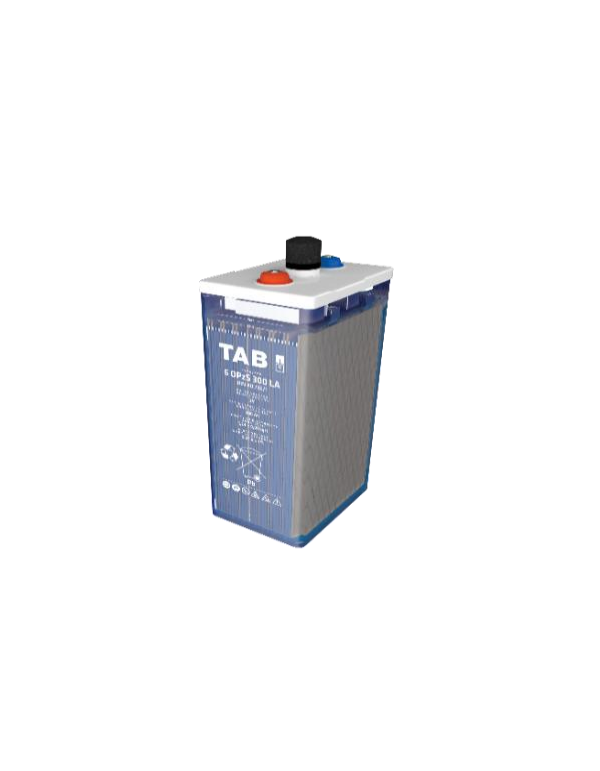
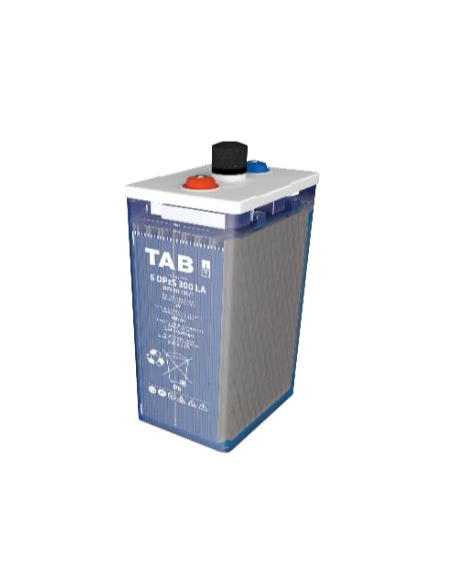

Stationary Battery Tab 350Ah 2V 5 OPzS 350
5OPzS350TB
€191.19
Tax included
The Stationary Battery Tab 5 OPzS 350 concentrate a nominal capacity of 350 ah in a glass of 2v with a fingerprint 124 x 206 mm, thanks to his 5 tubular positive plates of high format (471 mm tall) It is a robust accumulation solution for isolated photovoltaic installations, telecommunications and emergency feeding systems. In slow downloads delivery 553 Ah in C120 and 574 Ah in C240, which facilitates designing banks with prolonged autonomies. The positive plate with alloy Bajo Antimony (≤1.65% SB) guarantees 2,300 cycles at 60% depth of discharge and one 20 year design life In a flotation rate at 20 ° C. Meets the rules IEC 61427, IEC 60896-11, DIN 40736-1 and EN 50272-2, with a internal resistance of 0.608 MΩ, plugs antideflages ceramics and low European manufacture ISO 9001 and ISO 14001.
Detailed technical characteristics
Electrical specifications
- Model: TAB 5 OPzS 350
- Type of battery: stationary OPzS of open-acid, tubular positive plate
- Nominal voltage: 2V
- Nominal capacity (denomination DIN, C10:) 350 Ah
- CP240 capability (1.85 V / element, 20 ° C:) 574 Ah
- Capacity C120 (1.85 V / element, 20 ° C:) 553 Ah
- Capacity C48 (1.80 V / element, 20 ° C:) 498 Ah
- Capacity C24 (1.80 V / element, 20 ° C:) 444 Ah
- CP12 capacity (1.80 V / element, 20 ° C:) 413 Ah
- Internal resistance: 0,608 mΩ
- Short circuit current: 3,300 A
- Number of positive plates: 5
- Number of poles: 2
Physical specifications
- Long: 124 mm
- Width: 206 mm
- High no connectors: 471 mm
- High with installed connectors and covers: 485 mm
- Weight with electrolyte (approx.:) 28 kg
- Dry weight (approx.:) 21 kg
Design and materials
- Positive plate: tubular, special alloy of bajo Antimony (≤1.65% SB)
- Negative plate: grid-packet with optimized low antimony alloy
- Separators: Low resistance microporous PVC
- Electrolyte: diluted sulfuric acid
- Container: Transparent san high resistance to impact
- Cover: ABS high robustness
- Poles: premium design with brass insert M10 and rubber gasket, with the possibility of impedance measurement
- Connectors: atornillables, steel screws with encapsulated head on plastic, flexible isolated connectors (optional rigids)
- Plugs: antideflages ceramics, also available in funnel format
Operation data
- Life in cycles: 2,300 cycles to 60% DOD and 20 ° C
- Design life: 20 years in Flotation at 20 ° C
- Recommended operating temperature: 10 ° C at 30 ° C
- Maximum temperature: 55 ° C
- Autodescarga rate: approx. 2.5% monthly at 20 ° C
- Maximum storage without recharge: 3 months at 20 ° C, , 2 months at 30 ° C, , 1 month at 40 ° C
- Maintenance: low refill requirements
Standards and Quality
- IEC 61427 for photovoltaic energy systems
- IEC 60896-11 for open-acid-acid batteries
- DIN 40736-1 for elements OPzS
- EN 50272-2 safety for stationary batteries
- Manufacture in Europe with ISO 9001, , ISO 14001 and BS OHSAS 18001
Benefits of the stationary battery Tab 5 OPzS 350
The 5 OPzS 350 belongs to the series of vessels OPzS of tall format of Tab. Your great advantage over other lead solutions is the relationship between capacity and occupied surface: with the same floor as the 5 OPzS 250 (124 x 206 mm), it offers 100 Nominal Ah More thanks to higher tubular plates. For the installer, this means more compact banks and less glasses to achieve target capacity.
Tubular plate in front of flat plate
In a flat plate battery, like most aGM batteries and economic monoblocks, positive active matter is detached with each cycle. In the design OPzS, that active matter is housed within tubular pods that keep it in place, so the battery tolerates many more deep cycles. That is why tubular vessels are the standard in isolated installations for permanent use.
Documented life
Tab certifies 2,300 cycles 60% of DOD and 20 years of design life in flotation. The manufacturer's curves also show that life in cycles depends a lot on the temperature: at 20 ° C, the best performance is obtained, while at high temperatures available calendar. Keeping the bank in a fresh place is the best amortization guarantee.
Reliability and security in the battery room
The antideflagers ceramic plugs, the screws with encapsulated head and the polos with acid resistant rubber gasket they reduce the usual risks in handling open lead banks. Compliance with EN 50272-2 it provides a clear framework for installation.
If your project requires a battery without maintenance or in greater depth of useful download, in our store you can also compare with lithium batteries for self-consumption or with gel batteries of deep cycle.
Recommended applications
Isolated housing for permanent use
With 553 Ah in C120, a few vessels are enough to cover the night consumption of a home and keep reservation for several cloudy days. It is commonly combined with solar panels monocrystallines and a hybrid inverter or inverter-farger with open lead profile.
Professional and critical facilities
Repeaters of telecommunications, meteorological stations, solar pumps, signaling systems or SAI industrialists benefit from their long life in flotation and the possibility of measuring tension and impedance glass to glass for predictive maintenance.
Bank configuration and necessary space
Being an element of 2V, they need 6 glasses for 12V, , 12 for 24v and 24 for 48V. As a own estimate (it is not a data from the manufacturer), a bank of 24 glasses at 48V sum some 16.8 kWh nominal in C10 and around 672 kg of weight with electrolyte. Keep in mind the height of 485 mm with connectors when planning cabinets, banks or shelves for batteries.
So that the installation works as a complete system, in Tienda Solar you will find inverters solar, regulators and wiring. And if you want to deepen on the sizing of stationary batteries, visit the Blog Tienda Solar, where we publish purchase guides and technical articles developed by experts.
Frequently Asked Questions (FAQ)
1. Why 5 OPzS 350 has more capacity than 5 OPzS 250 if you both have 5 plates?
Because the plates of the 5 OPzS 350 higher. Both vessels share long and width (124 x 206 mm), but the 5 OPzS 350 471 mm high versus 355 mm. More plate surface is equivalent to more active matter and, therefore, to more capacity: 350 Ah nominal versus 250 ah.
2. What does it mean that C120 capacity is measured up to 1.85 V per item?
Indicates that the battery is downloaded during 120 hours a constant current until each glass reaches 1.85 V. In those conditions, at 20 ° C, Tab 5 OPzS 350 553 Ah. It is the reference value most used for solar installations isolated with several days of autonomy.
3. What happens if the battery works above 30 ° C?
Tab recommends a range of 10 ° C at 30 ° C and it admits 55 ° C at most. Above the recommended range, the manufacturer's curves show that the number of cycles is reduced significantly, so it is convenient to locate the bank in a cool and ventilated place.
4. How much do we have to fill water from the glasses?
It depends on the temperature, the loading regime and the use of the installation, so there is no fixed range. Tab indicates some low refill requirements thanks to the low antimony alloy. The container transparent it allows controlling the level in each review and replenish with distilled or demineralized water when necessary.
5. What function do the antideflagant ceramic plugs have?
During loading, batteries OPzS liberate gases. The antideflagant ceramic plug it allows its output but prevents a flame or outer spark to spread into the glass, improving the safety of the battery room. Even so, the place must have the ventilation required by the norm EN 50272-2.
6. Can I install these vessels in a system with Solar Kit isolated?
Yes. The Tab 5 OPzS 350 fulfills the norm IEC 61427 for photovoltaic systems and it is a usual option for solar kits of Isolated Housing. You just have to check that the regulator or inverter supports lead-acid batteries open and configure the load tensions indicated in the Tab Manual.
Tap to zoom