Your cart
There are no more items in your cart

Detailed technical characteristics
Electrical performance
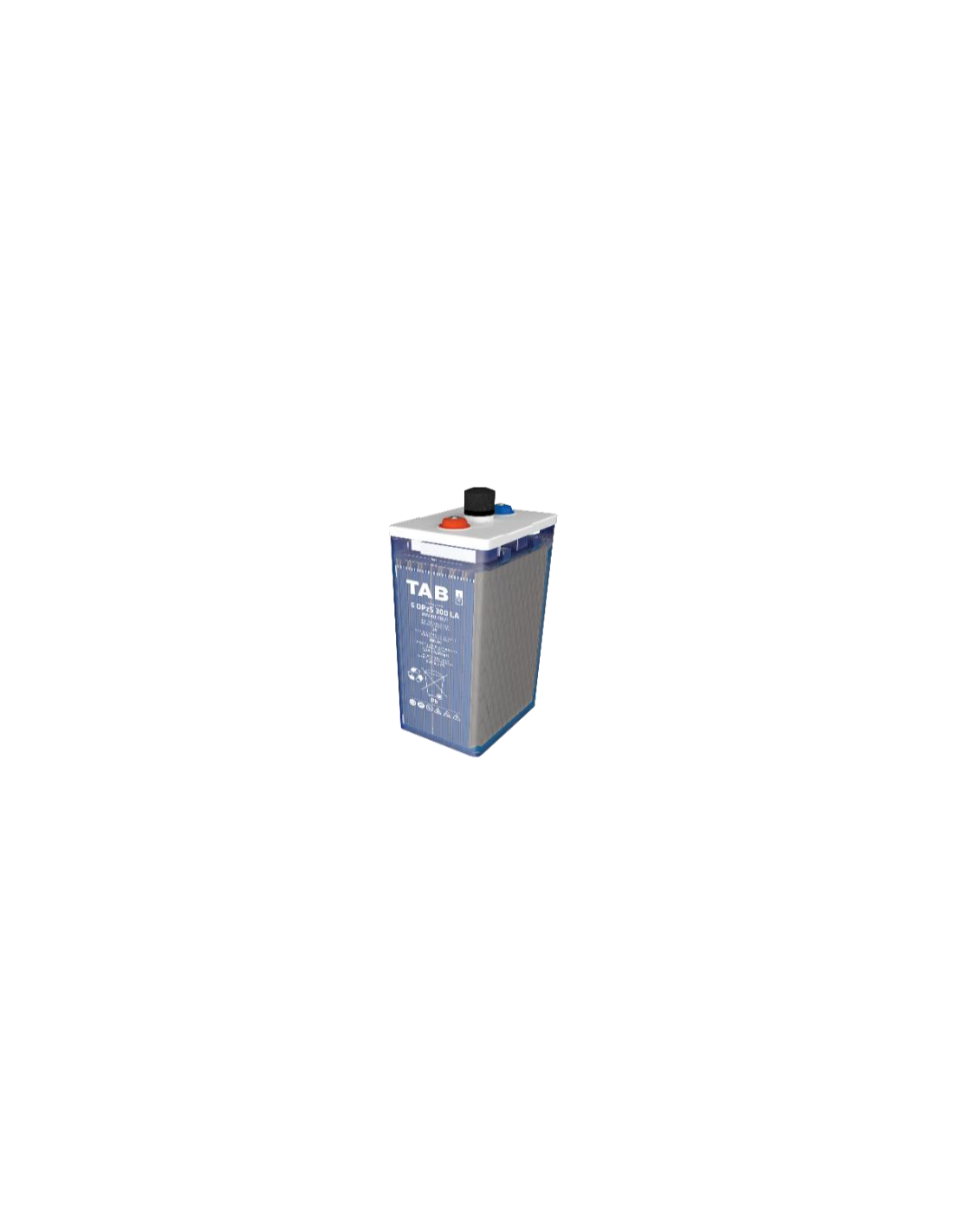
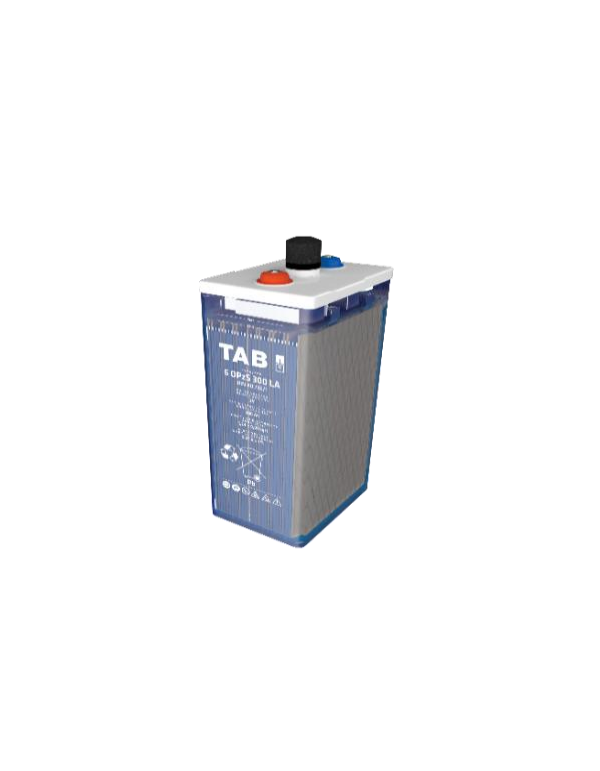
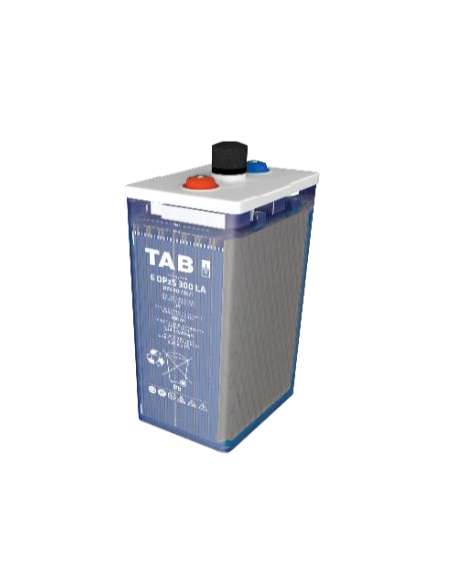
- Reference: TAB OPzS 420
- Technology: OPzS, lead-open acid with positive tubular plate
- Nominal voltage: 2V
- Nominal capacity (denomination DIN, C10:) 420 Ah
- C240 to 1.85 V / element (20 ° C:) 686 Ah
- C120 to 1.85 V / element (20 ° C:) 661 Ah
- C48 to 1.80 V / element (20 ° C:) 596 Ah
- C24 to 1.80 V / element (20 ° C:) 530 Ah
- C12 to 1.80 V / element (20 ° C:) 494 Ah
- Internal resistance: 0,518 mΩ
- Short circuit current: 3,900
- Positive plates: 6
- Poles: 2
Measurements and weight
- Long: 145 mm
- Width: 206 mm
- High no connectors: 471 mm
- High with connectors and covers: 485 mm
- Weight with electrolyte (approx.:) 34 kg
- Dry weight (approx.:) 24 kg
Construction
- Positive plates: tube special alloy of bajo Antimony (≤1.65% SB)
- Negative plates: gridboat with optimized low antimony alloy
- Separators: Low resistance microporous PVC
- Electrolyte: diluted sulfuric acid
- Glass: Transparent san high resistance to impact
- Cover: Sturdy abs
- Poles: brass insert M10 and rubber gasket, acid resistant and suitable for impedance measurement
- Connectors: bolted with encapsulated head steel screws, flexible isolated from series and rigid optional
- Plugs: antideflages ceramics, with choice of funnel ceramic plugs
Service benefits
- Cycles: 2.300 to 60% DOD, 20 ° C
- Design life: 20 years in Standby, 20 ° C
- Recommended temperature: 10 ° C at 30 ° C
- Maximum temperature: 55 ° C
- Self: approx. 2.5% per month at 20 ° C
- Maximum storage time: 3 months at 20 ° C, , 2 months at 30 ° C or 1 month at 40 ° C
- Need for filling: low
Regulatory
- IEC 61427: batteries for photovoltaic systems
- IEC 60896-11: standard lead-acid batteries open
- DIN 40736-1: elements OPzS
- EN 50272-2: stationary battery security
- ENOUGHT Certified ISO 9001, , ISO 14001 and BS OHSAS 18001
Benefits of the stationary battery Tab 6 OPzS 420
The 6 OPzS 420 combines a compact plant of 145 x 206 mm, a contained height of 471 mm and a simple configuration of two poles. For the installer, this translates into a very specific practical advantage: high capacities are achieved without resorting to four-pole vessels, larger and with a more complex connection, nor to higher height elements that do not fit in all cabinets.
High capacity in the same space
Compared to the 6 OPzS 300, which occupies exactly the same surface area, the 6 OPzS 420 contributes 120 Ah Nominal More thanks to its highest plates (471 mm facing 355 mm). And against 5 OPzS 350, add a sixth positive plate and 70 Ah with only 21 mm longer. It is the logical choice when the consumption of the housing or the equipment requires more autonomy without multiplying benches.
Low internal resistance
With 0,518 mΩ, this glass clearly improves to 6 OPzS 300 (0,575 mΩand at 5 OPzS 350 (0,608 mΩ). In practice, this means lesser voltage drop before current peaks, less warming in demanding downloads and better behavior with inverters- greater powerful or with inverters hybrid who work with variable loads.
Durability of the tubular plate
The tubular positive plate maintains the active matter confined and supports daily cycling much better than flat plate batteries, such as aGM batteries. With 2,300 cycles 60% of DOD and 20 years of design life, the cost per cycle is very competitive in isolated daily installations. The TAB curves also confirm that, reducing the depth of discharge, the number of cycles grows considerably.
Predictable maintenance
The transparent glass it allows visually inspecting the level of electrolyte and plates, and the design of screwing connectors supports tension and impedance measurements individual. This facilitates timely detecting any unbalanced element and planning the bank's maintenance.
Dimensioning and commissioning
Banks of 24V and 48V
With elements of 2V, they need 12 glasses for 24V and 24 glasses for 48V. As a calculated estimate calculated on nominal capacity (it is not a manufacturer's data:)
- 24V Bank (12 glasses:) some 10 kWh nominal in C10 and some 408 kg electrolyte
- 48V Bank (24 glasses:) some 20 kWh nominal in C10 and some 816 kg electrolyte
These figures help to foresee the space, the resistance of the soil and the power of the inverter solar that is going to be installed.
Load and configuration inverter
The loading equipment must have a profile for lead-acid batteries open with phases of absorption, flotation and equalization. Concrete tensions are not listed on the Technical Sheet and must be taken from the Tab Manual. For low voltage disconnection, the manufacturer publishes reference curves depending on the discharge current and the desired depth of discharge.
Alternatives according to the type of installation
If you are looking for a solution without maintenance and with a higher depth of useful download, also compare with our lithium batteries. And to complete your system, you can combine the bank with solar panels of high efficiency or from one of our solar kits.
On Tienda Solar we put at your disposal all the material for your installation, and in the Blog Tienda Solar you will find purchase, comparative and technical articles written by experts to help you dimension your battery bank.
Frequently Asked Questions (FAQ)
1. Why is internal resistance important in a battery OPzS?
The internal resistance determines how much the Bank's tension falls when a high current is demanded. With 0,518 mΩ, tab 6 OPzS 420 maintains the tension for startups or consumer peak starts, avoiding unwanted disconnections of the inverter and reducing heat losses.
2. What is the difference between full weight and dry weight?
The full weight (34 kg) it corresponds to the glass with its electrolyte, which is as it works in the installation. The dry weight (24 kg) it is that of the glass without electrolyte. To calculate the load on the floor or the bench, the full weight should always be taken.
3. How can I check the state of loading of the glasses?
In open-acid-acid batteries, the most reliable method is to measure the electrolyte density with a densimeter, complemented by the measurement of the rest of each glass. The design of Tab screwing connectors facilitates these measurements element to element.
4. What is the use of equalization?
Equalization is a voltage controlled load somewhat higher than usual that is periodically applied to equalize the state of charge of all the beams of the bank and homogenize the electrolyte. It is a habitual practice in batteries OPzS; the voltage and the frequency must follow the indications of the Tab's Manual.
5. Can I use Tab 6 OPzS 420 with a hybrid inverter?
Yes, as long as the inverter support lead-acid batteries and allow manually configuring load voltages and disconnection thresholds. Most of inverters hybrids for isolated installations include this option, although it is convenient to confirm it on its technical sheet.
6. How many years can this glass last in an isolated home?
Tab indicates a 20 year design life in flotation and 2,300 cycles 60% of DOD at 20 ° C. The actual duration depends on the daily depth of discharge, the temperature of the premises and the maintenance. A well-sized bank, located between 10 ° C and 30 ° C and with periodic reviews is the best way to approach these figures.
Tap to zoom