
Your cart
There are no more items in your cart
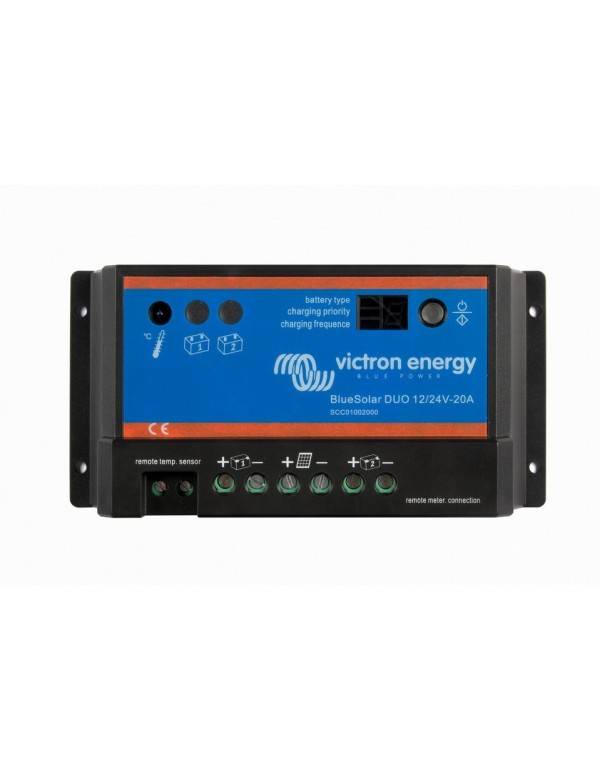
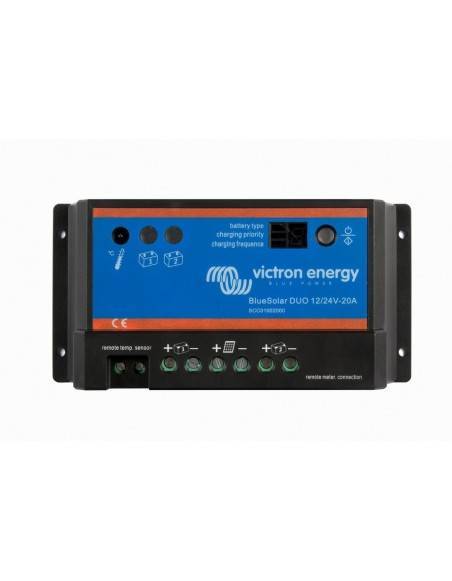

PWM loading regulator Victron BlueSolar Duo 20A 12V / 24V
BS PWM-D20
€62.50
Tax included
The solar load controller Victron BLUESOLAR PWM DUO 20A is a high-reliability electronic device designed to optimize photovoltaic performance in mobile or isolated installations by an advanced system capable of loading two independent batteries simultaneously, such as the boot battery and service in Boats or caravans. This regulator efficiently manages a 20A nominal load current with automatic voltage detection at 12V and 24V, supporting a strict 28V maximum solar voltage technical roof for fields of of 36 cells and 55V for 72 cell modules. Its architecture integrates programmable software that allows to modify the current proportion injected to each accumulator, adapting the algorithms to GEL, AGM and flooded technologies, backed by an internal temperature sensor and total protection against short circuits, Overcurrants and reverse polarity in a compact 180 gram chassis.
Victron BlueSolar PWM Duo 20A: Simultaneous Management of Two Independent Batteries, Programmable Loading and Nautical Safety and Camper
Optimizing space and energy resources in recreational vehicles, boats or stations isolated with generator requires components designed to solve specific problems. The regulator Victron BlueSolar Pwm Duo 12V / 24V 20A Solven of one of the greatest challenges of these facilities: the need to keep the motor start-up battery in perfect load (either from the vehicle or from a generator group) while supplying energy in a priority form to the Bank of Service Batteries or Interior, all controlled from a Unique high-end photovoltaic device.
Double load algorithm and parameterizable current distribution
The main competitive advantage of this model versus standard market PWM controllers is its dual exit architecture. The BlueSolar Duo allows analytically programming the exact current proportion that is derived to each of the two storage benches connected. Although factory it is configured with a standard setting that distributes the energy to equal parts (50% / 50%), the installer can modify these ranges to prioritize the service charge and allocate a minor maintenance percentage to the boot battery.
Its technology Modulation by pulse width (PWM) It works with an advanced algorithm that adjusts the load voltages according to the specific chemistry of each accumulator, being fully compatible with flooded gel, AGM and lead-acid batteries. This guarantees a correct gas recombination and actively prevents premature sulfation of the vessels. If you are projecting the sturdy placement or fixing of your solar modules on the curved roof of a motorhome or the cover of a boat, we invite you to consolidate the installation using the specific supports of our section of
Advanced electronic protection and serial thermal compensation
The industrial robustness of this 20A equipment lies in the integration of automated passive safety barriers that arm the system against wiring errors or contingency peaks in consumption. The photovoltaic entrance admits a 28V maximum solar tension In 12V battery systems and scale up to 55V When it operates in ranges of 24V. The electronic circuit has active defenses against short circuits, overcurrent by excess demand and protection against polarity investment both in the terminals of the Photovoltaic and accumulators.
Additionally, the internal temperature sensor performs a continuous mathematical correction of the voltage thresholds based on the variations of the environment, ensuring that the batteries do not suffer critical overloads in summer or stay short of energy during the winter. Its dimensioning is direct and is optimized to process the energy of
Technical characteristics:
-
Battery bank voltage: Intelligent automatic detection for 12V and 24V ranges.
-
Nominal load current: 20 A.
-
Maximum permitted solar tension: 28 V (in 12V networks) / 55 V (in 24V networks).
-
Compatibility of modules: Optimized for of 36 cells (12V systems) and 72 cells (24V systems).
-
Dual output capacity: Independent and simultaneous load of two battery benches.
-
Current distribution: Programmable (factory setting with distribution identical to both outputs).
-
Compatibility of technologies: Selectable profiles for flooded gel, AGM and lead batteries.
-
Integrated assurances: Active protection against short circuit, overcurrent and reverse polarity ( and batteries).
-
Thermal management: Internal temperature sensor for automatic voltage compensation.
-
Dimensions of the envelope: 76 mm wide x 153 mm high x 37 mm deep.
-
Structural net weight: 180 g.
-
Availability: In stock.
Frequently asked questions
1. How does the regulator perform Victron BlueSolar Duo load two batteries at a time?
The equipment has independent output circuits on its terminals. Its internal software distributes the current generated by the solar boards towards both storage benches intelligently. By default, it divides the energy to 50%, but allows to program the percentage to allocate, for example, 80% to the caravan service battery and the remaining 20% to keep the engine start.
2. Can I connect two batteries that have different voltages or technologies on the same equipment?
The nominal voltage of the system (12V or 24V) is self-trained when connecting the first battery and must be identical in both outputs (a battery can not be loaded to 12V and another to 24V at a time). However, the software does allow adapting and adjusting the final load voltage levels according to the type of internal construction of the accumulators, whether gel, AGM or lead-lead-acid.
3. What kind of Are you the most suitable for this PWM DUO regulator 20A?
If your installation and your batteries work at a 12V voltage, you must use Solar Solar of 36 cells (usually plates up to 200W). If your battery bank is configured to 24V, you must connect 72 cells solar or, failing, coupling Of 36 cells in two series in two without exceeding the maximum voltage voltage 55V.
4. What happens if an accidental short circuit occurs in the installation wiring?
The regulator incorporates a complete ecosystem of passive electronic protections. Given a short circuit on the lines of charge, an overcurrent by excess consumption or a mistake when connecting the positive and negative cables (reverse polarity), the regulator stops the energy transfer automatically to safeguard its internal components and avoid breakdowns in accumulators.
5. What is the internal temperature sensor that the chassis has been integrated?
Batteries modify their internal resistance and their chemical behavior according to environmental thermal conditions. The internal sensor constantly measures the temperature of the technical room or the passenger compartment and automatically corrects the load voltages: reduces tension in hot eras to avoid evaporation of the electrolyte and elevates it in winter to ensure a complete filling.
Tap to zoom
