
Your cart
There are no more items in your cart
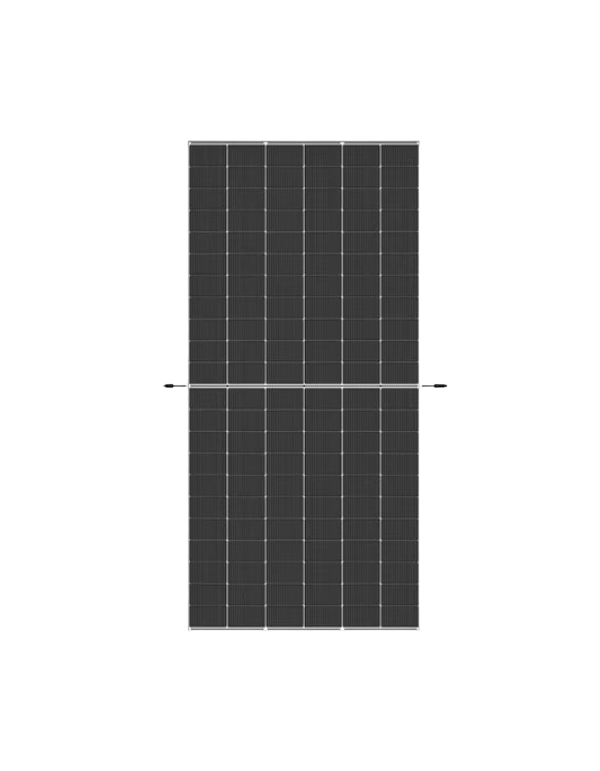

Monocrystalline solar panel Trina Solar Vertex N 640W TSM-Neg19RC.20 Bifacial double glass
TSM-NEG19RC.20
€123.42
Tax included
The solar panel Trina Solar Vertex N 640W (Model TSM-Neg19RC.20) It is a monocrystalline module Bifacial double glass High power that bases its performance in advanced technology N-Type I-Topcon. By incorporating Super Multibusbar Technology (Smbb), minimizes losses due to internal resistance and optimizes light uptake, achieving a module efficiency up to the 23.0% on his front face (base nominal power of 590-620W) and reaching with total ease a Total equivalent power of 640W Through an active bifacial gain of only 5% on your back face. With a guaranteed degradation of 1% the first year and the 0.4% per year until the year 30, it is prepared for system voltages 1500V DC. It stands out for its high mechanical tolerance against snow (5400 Pa) and wind (2400 Pa), configured as a solution of excellent reliability for large-scale commercial and industrial projects.
Trina Solar Vertex N 640W: Silicon N-Type I-Topcon, Dual Glass Structure and Bifacial Performance with Active Gain
Contemporary photovoltaic engineering is decisively oriented to squeeze spatial and financial efficiency, reducing the leveling cost of energy (LCOE) and optimizing the system balance budget (BOS). The solar panel Trina Solar Vertex n tsm-neg19rc.20 series Vertex n materializes this advance through a design bifacial double glass with monocrystalline silicon cells n. Designed to mitigate losses by shading and thermal stress, this panel takes advantage of the albedo of the installation to consolidate a net equivalent generation of 640W, transforming the key component to maximize production in commercial covers, industrial ships or fixed structures on the ground.
High density I-Topcon cells, SMBB and equivalent power of 640W
The Trina Vertex N generation pillar is cimped on cells N-Type I-Topcon of new generation, which neutralize the effect of light-induced degradation (LID) that usually redes the capacity of type P type modules. The addition of technology SMBB (Super Multi-Busbar) maximizes photon entrapment inside the silicon, shortens the path of the electric current and reduces the resistance in series. All this converges in an outstanding module efficiency up to 23.0% and an unbeatable behavior against diffuse radiation or very covered skies.
By integrating an architecture bifacial, the back face of the module takes advantage of the indirect light reflected by the environment. With a bin of frontal power base (for example, the 610W model), the module manages to certify a cOMBINED REAL POWER OF 640WP with only 5% gain by rear reflection, being able to stretch up to a 30% extra energy on optimal surfaces. To efficiently channel this massive flow of electricity and coupling it safely with your distribution network, you can integrate these modules with the technology of the
Hostility Hostility Glass before hostile environments and 1500V connectivity
The physical durability of the series TSM-neg19rc.20 it is guaranteed by its encapsulation of double Glass (Dual Glass). When you dispense with the classic posterior plastic sheet (backsheet), the cells are brightly brightly against extreme humidity, atmospheres with high marine salinity, agricultural ammonia and bursts of desert sand. To this is added a non-destructive cutting process that eliminates the microfixers at the edges of the cell, conferring the panel a static resistance of up 5400 PA Snow Loading (Front) and 2400 PA Wind Charging (Back). To strengthen this set of modules under strict mechanical safety standards, you will find specific profiles and supports in our catalog of
At the electrical configuration level, its security insulation is optimized to hold high system tensions up to 1500 V DC, which facilitates the design of chains (strings) Longer and decreases the costs in copper wiring. If your project's focus includes energy accumulation to optimize nocturnal consumption or stabilize the network, we suggest complementing the system with the equipment available in our section of
Technical characteristics:
-
Maximum equivalent power (PMAX): 640 WP (Achieved by Frontal Bifacial Combination + Rear).
-
Nominal front base range: 590W A 620W according to factory classification.
-
Maximum Module Efficiency: 23.0%.
-
Voltage at the point of maximum power (VMPP): 39.7V at 41.4V (according to base model).
-
Current at the point of maximum power (ImpP): 15.60A to 16.49A (Scalable with rear gain).
-
Voltage in open circuit (VOC): 47.6V to 49.2V.
-
Short circuit current (ISC): 16.48a to 16.63a.
-
Type of cells: Monocrystallines with technology N-Type I-Topcon.
-
Driving Configuration: Technology SMBB (Super Multi-Busbar).
-
Protection structure: Double Glass (Bifacial Dual Glass) symmetric.
-
Bifacial gain contribution: Up 30% additional production on the back.
-
Coefficient of power temperature: -0.29% / ° C.
-
Maximum voltage supported by the system: 1500 V DC (IEC).
-
Maximum series fuse: 35 a.
-
Safety connection box: Degree Ip68 with integrated bypass diodes.
-
Static load resistance: Leader 5400 pa and rear 2400 pa.
-
Output connectors: TS4 / MC4 EVO2 compatible.
-
Dimensions of the panel: 2384 mm long x 1134 mm wide x 30 mm thick.
-
Net structural weight: 33.7 kg.
-
Factory guarantees: Until 25 years of product and 30 years of linear power.
Frequently Asked Questions section (FAQ)
- How does this panel reach the 640W power if its base range is less? The key resides in its nature bifacial. The i-Topcon monocrystalline silicon cells are encapsulated between two transparent glass layers. A panel with a front base classification of, for example, 610W, reaches with total ease 640W of combined total power when receiving only a 5% energy gain through the light reflected on the ground (Albedo) on its back face.
- What real advantages does SMBB (Super Multi-Busbar) technology offer Trina Solar? Design SMBB enter a dense network of fine wires metal conductors on the surface of the cell. By drastically shortening the distance that the electrons go through the cell, the internal resistance of the module decreases and the heat loss is mitigated in the form of heat. In addition, these round section yarns improve optical trapping by reflecting incident light back towards silicon, raising efficiency at 23.0%.
- Why is the double glass (Dual Glass) architecture in humid or coastal areas? The conventional solar use a plastic rear sheet (backsheet) That with the years it can suffer microscopic wear by humidity or UV radiation. The structure Dual Glass enclose the silicon between two solid sheets of tempered glass. Being a totally inert and impenetrable barrier, it cancels the penetration of moisture, salt fog or corrosive gases such as ammonia, completely eliminating the failures by PID (degradation by induced potential).
- What is the temperature coefficient and why the value of -0.29% / ° C of this panel is so beneficial? The temperature coefficient indicates the percentage of power that loses a module for each grade that the cell exceeds 25 ° C standard. The N i-Topcon type silicon of Trina Solar it has a low coefficient of only -0.29% / ° C. In the middle of summer, when the they can easily reach 65 ° C on the roof, this module retains a substantially greater generation capacity than the traditional.
- How is the 30-year linear power guarantee offered Trina Solar? Due to the very high physical and chemical stability of type N type, Trina Solar guarantees that degradation during the first year of use will be limited to a maximum of 1%. From the second year and until completing the three decades of continuous service, annual wear is restricted to a strict 0.4%. This ensures that, in the year 30, the module continues operating at least an outstanding 87.4% of its initial nominal performance.
- Power (W)
- 600 - 650
- Height (cm)
- 230 - 239.9
- Width (cm)
- 110 - 119.9
- Frame
- Black
- Short Circuit Current Isc (A)
- 16 - 16.99
- Max Power Voltage VMPP (V)
- 39 - 40
Tap to zoom

