Your cart
There are no more items in your cart
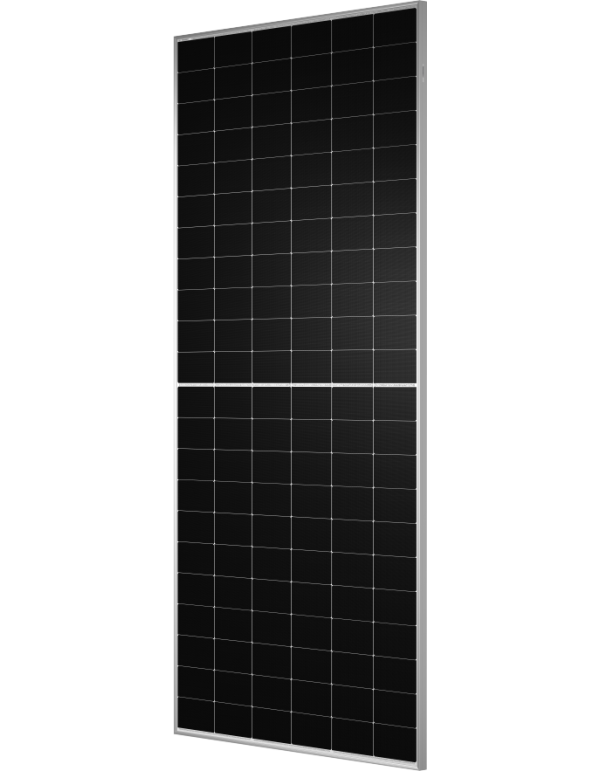
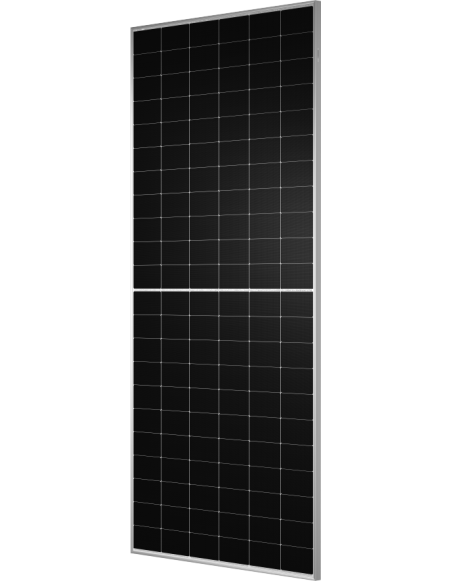

Tongwei 630W Bifacial N-Type Solar Panel TNC 2.0 TWMNH-66HD630
TWMNH-66HD630
€105.50
Tax included
The Tongwei 630W TWMNH-66HD630 solar panel features TNC 2.0 N-type (TOPCon) technology with 132 half-cells in a bifacial dual-glass design, achieving 23.3% efficiency and a rated power of 630 Wp under STC. Its rear side captures reflected light with a bifaciality factor of 80±5%, boosting output to 695.4W under BNPI conditions and up to 724W with a 15% rear-side gain. Its Pmax temperature coefficient of -0.28%/°C limits losses during the hottest months, and its 1500V DC design (Voc 49.50V, Isc 16.18A) allows longer strings on industrial rooftops and ground-mounted plants. With 2.0 mm front and rear glass, an IP68 junction box and a 5,400 Pa load rating, it comes with a 12-year product warranty and a 30-year linear power warranty, guaranteeing 87.4% of its power at the end of the period.
Benefits of the Tongwei 630W TNC 2.0 Bifacial Solar Panel
The Tongwei TWMNH-66HD630 belongs to the second generation of TNC technology (Tongwei's N-type TOPCon platform) and is designed for those seeking maximum output per square metre, the lowest possible degradation and the lowest levelised cost of energy (LCOE) over decades. It is not just another module in our solar panels catalogue: it is a premium module that combines high rated power, genuine bifaciality and a 30-year linear power warranty that few manufacturers offer in this segment.
TNC 2.0 N-type technology: more energy from less space
N-type cells with TOPCon passivation reduce recombination losses, allowing this module to reach 23.3% efficiency with 630 Wp over a surface of 2.70 m², equivalent to a power density of approximately 233 W/m². In practice, this means fewer panels, less mounting structure, less cabling and fewer installation hours to reach the same peak power as with previous-generation modules. The 132 half-cell (6×22) layout splits the current of each cell, reduces resistive losses and improves performance under partial shading thanks to its 3 bypass diodes.
Better performance in the heat: -0.28%/°C temperature coefficient
In Spain and Portugal, panels operate for many hours in summer with cell temperatures that easily exceed 60 °C. This is where N-type technology makes the difference: the Pmax temperature coefficient of -0.28%/°C is clearly lower than the typical -0.34%/°C to -0.35%/°C of P-type PERC modules. With a cell temperature of 65 °C (40 °C above STC), the Tongwei 630W loses around 11.2% of its power, while an equivalent PERC module would lose between 13.6% and 14%. That difference translates into additional kWh precisely during peak-demand hours.
Low degradation and long-term durability
Phosphorus-doped N-type wafers are not affected by the light-induced degradation (LID) mechanism associated with the boron-oxygen complex in P-type cells. On top of this, the 2.0 mm semi-tempered dual-glass construction protects the cells against moisture ingress and micro-cracks, two of the factors that most accelerate PID degradation and ageing in the field. The result is reflected in the warranty: only 1% degradation in the first year and 0.4% per year from the second year onwards.
A warranty built for 30-year investments
Tongwei backs this module with a 12-year materials and workmanship warranty and a 30-year linear power warranty. For installers and investors, this means a predictable production horizon and a solid basis for calculating the return on industrial self-consumption projects, C&I rooftops or grid-connected plants with high-power grid-tie inverters.
Bifacial Production: How Much Extra Energy Can You Expect?
The rear side of the TWMNH-66HD630 captures radiation reflected by the ground or roof (albedo) and converts it into electricity with a bifaciality factor of 80±5%. The actual gain depends on the type of surface, the mounting height and the spacing between rows. These are the values published by Tongwei for the 630W model:
| Scenario | Maximum power (Pmax) | Equivalent efficiency |
|---|---|---|
| Front side only (STC) | 630 W | 23.3% |
| 5% rear-side gain | 661 W | 24.5% |
| BNPI (135 W/m² rear) | 695.4 W | - |
| 15% rear-side gain | 724 W | 26.8% |
| 25% rear-side gain | 787 W | 29.1% |
How to maximise bifacial gain
- Light-coloured surface beneath the panels: white gravel, reflective membranes or light-coloured roofs significantly increase albedo compared with soil or grass.
- Mounting height: raising the lower edge of the panel off the ground improves uniform illumination of the rear side.
- Suitable structure: avoid rails or profiles shading the back of the cells; choose solar panel mounting structures designed for bifacial modules.
- Ground-mounted and flat-roof installations: these are the scenarios where bifaciality delivers the greatest return, compared with flush-mounted installations sitting close to the roof.
Linear Power Warranty: Guaranteed Production for 30 Years
Tongwei's power warranty sets a linear curve with 1% degradation in the first year and 0.4% per year thereafter. Applied to the 630W model, this means:
- Year 1: 99.0% of rated power, i.e. 623.7 W guaranteed.
- Year 25: 89.4% of rated power, i.e. 563.2 W guaranteed.
- Year 30: 87.4% of rated power, i.e. 550.6 W guaranteed.
After three decades in operation, each module still guarantees more power than many newly manufactured mid-range panels, making it a particularly profitable choice for projects with long-term financing or PPA contracts.
String Design Guide for Installers
The TWMNH-66HD630 supports a maximum system voltage of 1500V DC, allowing long string configurations in industrial installations and ground-mounted plants. Below is an indicative calculation based on the datasheet values (Voc 49.50V and Voc temperature coefficient of -0.24%/°C), using a minimum cell temperature of -10 °C as reference:
- Voc corrected to -10 °C: approximately 53.7 V per module.
- 1500V DC systems: up to 27 modules in series (approx. 1,449 V at -10 °C).
- 1000V DC inverters: up to 18 modules in series (approx. 966 V at -10 °C).
- 600V DC inverters: up to 11 modules in series (approx. 590 V at -10 °C).
Important: these values are indicative only. The final number of modules per string must be calculated using the site's historical minimum temperature and the MPPT and start-up voltage ranges of the chosen inverter.
Inverter current compatibility
With an Imp of 15.33A and an Isc of 16.18A at STC, rising to 17.86A under BNPI conditions due to the rear-side contribution, it is essential to check that the maximum short-circuit current accepted by each MPPT of the inverter is equal to or higher than these values. Most latest-generation solar inverters are already designed for high-current modules, and for self-consumption systems with storage we recommend hybrid inverters with high input current per MPPT.
Installation, Dimensions and Logistics
Format and mounting
Measuring 2,382 × 1,134 × 30 mm and weighing 32.2 kg, the Tongwei 630W is a large-format module that requires two-person handling and a structure sized for its length. Its anodised aluminium frame features mounting holes at 400, 790 and 1,400 mm spacing, compatible with most fixing systems on the market, as well as grounding holes. The maximum static load of 5,400 Pa on the front and 2,400 Pa on the rear makes it suitable for areas with high snow and wind loads, always following the clamping zones specified by the manufacturer.
Cabling
Each module includes 4.0 mm² cables with a length of +400 mm / -200 mm or ±1,400 mm (length customisable on request), making it easy to connect in portrait, landscape or leapfrog configuration on long rows.
Logistics for professionals
- 36 panels per pallet, equivalent to 22.68 kWp per pallet.
- 720 panels per 40' HC container, equivalent to 453.6 kWp per container.
Which Installations Is the Tongwei 630W Ideal For?
- Commercial and industrial (C&I) rooftops: its high power density maximises the kWp installed on factories, warehouses and flat roofs with limited space.
- Ground-mounted solar plants: bifaciality, 1500V voltage and low degradation reduce the project's LCOE.
- Agricultural self-consumption and solar pumping: ideal for ground-mounted installations on farms and estates with available land.
- Homes with plenty of space or ground-mounted systems: for homeowners who prioritise maximum power with the fewest modules, especially when combined with lithium batteries to make the most of surplus energy.
If you are looking for a complete solution with all components already sized, check out our solar kits for self-consumption.
Tongwei: Tier 1 Manufacturer with Certified Quality
Tongwei Solar is one of the world's largest photovoltaic cell manufacturers and is classified as a Tier 1 manufacturer by BloombergNEF, a key indicator of financial strength and bankability for large-scale projects. It also holds an EcoVadis Gold (Top 5%) sustainability rating, Certisolis carbon footprint certification, the TÜV NORD Type Tested mark and CE marking.
Product certifications
- IEC 61215 (2021) and IEC 61730 (2023): design qualification and safety of photovoltaic modules.
- IEC TS 62804: potential-induced degradation (PID) resistance test.
- IEC 61701: salt mist corrosion resistance, key for coastal installations.
- IEC 62716: ammonia corrosion resistance, relevant for livestock farms.
- IEC 60068-2-68: sand and dust abrasion resistance.
Management systems
- ISO 9001:2015 (quality), ISO 14001:2015 (environment), ISO 45001:2018 (occupational health and safety), ISO 50001:2018 (energy management) and IEC 62941:2019 (quality system for PV module manufacturing).
Pre-order the Tongwei 630W at Tienda Solar
At Tienda Solar we work with Tier 1 manufacturers and advise both professional installers and private customers on the design of their installation. This model is available for pre-order, with stock expected to arrive on 19 October 2026: reserving your units now guarantees availability for your end-of-year projects. For questions about sizing, compatibility or regulations, visit the Tienda Solar Blog, where our experts publish buying guides, technical advice and specialist analysis on solar energy.
Detailed Technical Specifications
Electrical characteristics (STC)
- Model: TWMNH-66HD630
- Maximum rated power (Pmax): 630 W
- Open-circuit voltage (Voc): 49.50 V
- Short-circuit current (Isc): 16.18 A
- Voltage at maximum power (Vmp): 41.10 V
- Current at maximum power (Imp): 15.33 A
- Module efficiency: 23.3%
- Power tolerance: 0 ~ +3%
- STC conditions: irradiance 1,000 W/m², cell temperature 25 °C, AM 1.5; measurement tolerance ±3%
Electrical characteristics (BNPI)
- Maximum rated power (Pmax): 695.4 W
- Open-circuit voltage (Voc): 49.50 V
- Short-circuit current (Isc): 17.86 A
- Voltage at maximum power (Vmp): 41.10 V
- Current at maximum power (Imp): 16.92 A
- BNPI conditions: front irradiance 1,000 W/m², rear irradiance 135 W/m², cell temperature 25 °C, AM 1.5
Power by rear-side gain
- 5% gain: 661 W / efficiency 24.5%
- 15% gain: 724 W / efficiency 26.8%
- 25% gain: 787 W / efficiency 29.1%
Temperature coefficients
- Pmax temperature coefficient: -0.28%/°C
- Voc temperature coefficient: -0.24%/°C
- Isc temperature coefficient: +0.046%/°C
Operating parameters
- Operating temperature: -40 °C to +70 °C
- Maximum system voltage: 1500 V DC
- Maximum series fuse rating: 30 A
- Pmax bifaciality factor: 80±5%
- Voc bifaciality factor: 98±5%
- Isc bifaciality factor: 80±5%
Mechanical characteristics
- Cell type: TNC N-type (TOPCon), half-cell
- Number of cells: 132 (6×22)
- Dimensions: 2,382 ± 2 × 1,134 ± 2 × 30 mm
- Weight: 32.2 kg
- Front glass: 2.0 mm semi-tempered with anti-reflective (AR) coating
- Rear glass: 2.0 mm semi-tempered
- Frame: anodised aluminium alloy
- Junction box: IP68, 3 bypass diodes
- Cable cross-section: 4.0 mm²
- Cable length: +400 mm / -200 mm or ±1,400 mm (customisable)
- Maximum static load: 5,400 Pa (front) / 2,400 Pa (rear)
Packaging
- Units per pallet: 36 panels
- Units per 40' HC container: 720 panels
Warranties
- Product warranty (materials and workmanship): 12 years
- Linear power warranty: 30 years
- First-year degradation: 1%
- Subsequent annual degradation: 0.4%
- Guaranteed power at 25 years: 89.4%
- Guaranteed power at 30 years: 87.4%
Frequently Asked Questions (FAQ)
1. When will I receive the Tongwei 630W panels if I reserve them now?
The product is on pre-order and stock is expected to arrive on 19 October 2026. By reserving your units, you secure your allocation from the first batch and avoid running out of panels for your end-of-year installations.
2. What is the difference between the 630W STC power and the 695.4W BNPI power?
STC power (630 W) measures only the front-side output at 1,000 W/m². BNPI power (695.4 W) adds a rear irradiance of 135 W/m², representative of a bifacial installation with good albedo. Real-world output will fall between these two values or above them, depending on the reflective surface and mounting height.
3. Is this panel compatible with my inverter?
You need to check three parameters: that the string voltage at minimum temperature does not exceed the inverter's maximum voltage, that the string Vmp falls within the MPPT range, and that the maximum current per MPPT can handle the Isc of 16.18 A (up to 17.86 A with bifacial gain). Modern professional-grade hybrid inverters and grid-tie inverters are designed for modules with this current.
4. Can I use the Tongwei 630W on a home?
Yes, as long as you have enough space for a module measuring 2.38 m in length and weighing 32.2 kg. It is particularly worthwhile for homes with ground-mounted systems, pergolas or large roofs, where it achieves more power with fewer modules. For residential installations with module-level power electronics, check that the chosen microinverters can handle the power and current of this module.
5. How does a bifacial panel perform when flush-mounted on a roof?
In a flush-mounted installation close to the roof, the rear side receives very little light, so bifacial gain will be limited. Even so, the module retains its advantages of 23.3% efficiency, a low temperature coefficient and the durability of dual glass. Bifaciality delivers its greatest value on tilted flat-roof systems and ground-mounted installations.
6. What does it mean that the panel has 2.0 mm dual glass?
It means the cells are encapsulated between two sheets of glass instead of between glass and a backsheet. This construction offers greater protection against moisture, corrosion and micro-cracks, reducing long-term degradation and allowing Tongwei to offer a 30-year linear power warranty.
7. Is it suitable for coastal installations or farms?
Yes. The module is certified to IEC 61701 (salt mist corrosion) and IEC 62716 (ammonia corrosion), making it suitable for coastal installations and livestock farms. It also complies with IEC 60068-2-68 for sand and dust abrasion.
8. What mounting structure do I need for a panel of this size?
You need a structure designed for large-format modules (2,382 × 1,134 mm) and adapted to the wind and snow loads in your area. At Tienda Solar we offer flush-mounted, tilted and ground-mounted solar panel mounting structures compatible with modules with a 30 mm frame thickness.
- Power (W)
- 600 - 650
- Height (cm)
- 230 - 239.9
- Width (cm)
- 110 - 119.9
- Frame
- Silver
- Short Circuit Current Isc (A)
- 17 - 17.99
Tap to zoom