
Your cart
There are no more items in your cart
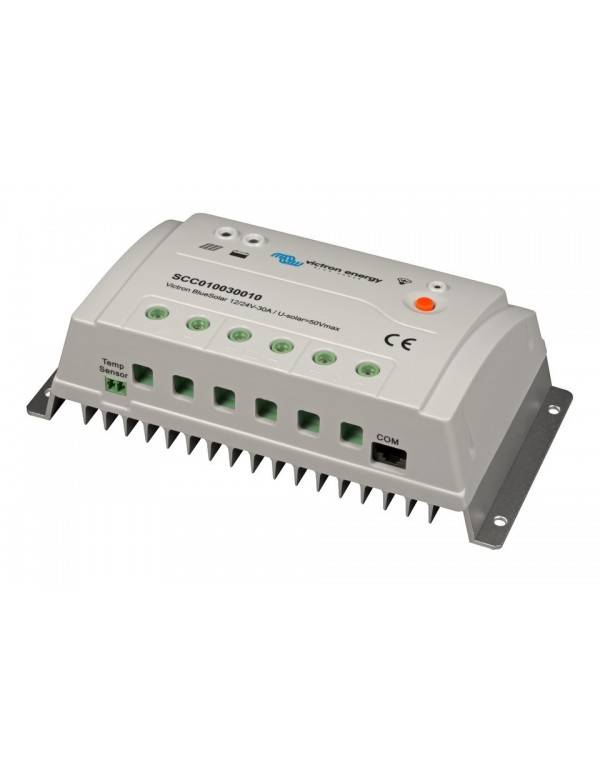
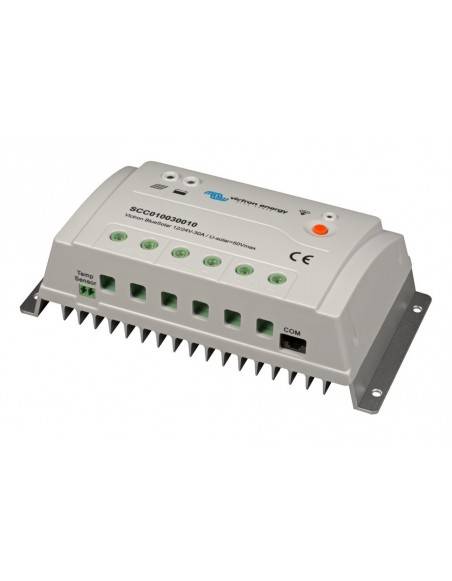

Programmable PWM loading regulator Victron BlueSolar Pro 30a 12V / 24V
BS PWM-P30
€105.03
Tax included
The solar load regulator Victron BLUESOLAR PWM PRO 30A is a programmable controller of high reliability and efficiency designed for the management of photovoltaic performance in isolated accumulation systems with automatic voltage detection at 12V and 24V. This device stands out at the technical level by its versatility of advanced configuration, ruling a powerful rated load current of 30A and adapting natively to the maximum solar tension of 28V for fields of of 36 cells in 12V batteries, or 55V for 72 cell modules in 24V systems. Its high-security electronic architecture integrates advanced software with an adaptive load algorithm in 3 parameterizable phases (equalization, absorption and flotation), added to an internal battery monitor and a low voltage smart disconnect channel in its Auxiliary output for consumption in continuous current, all concentrated in a robust chassis of 500 grams of net weight.
Victron BLUESOLAR PWM PRO 30A: 100% programmable photovoltaic control, advanced 3-phase algorithm and light management
The correct guidance of the energy generated in isolated installations and self-consumption networks demand demands capable of offering a thorough control over the load cycles. Unlike basic models with unalterable factory profiles, the regulator Victron BlueBlinking PWM Pro 12V / 24V 30A It gives the installer of an absolute parameterization capacity. When processing the direct current, the device allows to adapt each electric threshold to the specific needs of the plant, becoming the ideal component to maximize the life cycle of the accumulators.
Flexibility of advanced configuration and lighting timing
The main competitive advantage of the BlueSolar PWM-PRO range compared to conventional regulators lies in its customizable nature. Although it operates immediately with its default configuration, its loading phases can be altered freely: equalization, absorption and flotation. This level of control avoids the degradation of the battery due to overloads in high climatic requirement environments.
The device integrates a fully programmable lighting control function, critical for public lighting projects, road signaling or industrial beacon. The system autonomously regulates when activating consumption connected to its auxiliary output based on the daytime phases. In addition, it includes as standard an internal monitoring algorithm of the battery that analytically calculates the actual charge state of the accumulation bank. If you are projecting the structural fixation of your photovoltaic modules on industrial roofs or tilted tile covers to feed this system, we have the best mechanical options in our section of
Electrical safety barriers and optional thermal management
The physical robustness of this 30A controller is based on a complete ecosystem of passive and active electronic protections. The entry terminal tolerates a strict technical roof of 28V maximum solar tension In configurations with batteries at 12V and scale up to 55V photovoltaic entrance When the system identifies accumulators at 24V. Circuit engineering is protected in an integral manner against common errors in electric line, such as short circuits in load lines, demand overloads or reverse polarity failures at the rows of solar panels or the Batteries
To refine the accuracy of the chemical process, the equipment allows the optional coupling of an external temperature sensor, allowing to adjust the absorption and flotation voltages dynamically according to the temperature of the technical room. The dimensioning of the solar generator is direct, being optimized to squeeze the performance of
Technical characteristics:
-
Battery voltage: Intelligent automatic detection for 12V and 24V ranges.
-
Nominal load current: 30 a.
-
Maximum permitted solar tension: 28 V (in 12V networks) / 55 V (in 24V networks).
-
Compatibility of modules: of 36 cells (12V systems) and 72 cells (24V systems).
-
Charging algorithm: 3 phases (equalization, absorption and flotation) totally programmable.
-
Lighting function: Integrated time and twilight programming.
-
Auxiliary consumption output: Automatic disconnection by low voltage and manual control.
-
Active protections: Short circuit, overload and reverse polarity (in solar field and batteries).
-
Compatible accessories: Extended monitoring by remote panel and external thermal sensor (optional).
-
Physical dimensions of the chassis: 200 mm wide x 100 mm high x 57 mm deep.
-
Structural net weight: 500 g.
-
Statting: In stock.
Frequently Asked Questions section (FAQ)
1. What main difference exists between the Blue PWM Pro and the traditional PWM LIGHT models?
The fundamental difference is the programming capacity. While the LIGHT series works with fixed factory profiles, the BlueBlueBlims PWM Pro allows the user to precisely modify the equalization, absorption and flotation voltages. In addition, the PRO model includes battery monitoring functions and advanced lighting control.
2. Is it mandatory to buy the optional remote panel to work the regulator?
No, the regulator works fully automatically from the first moment with its default configuration for conventional lead-acid batteries. The remote panel is only necessary if you want to view the percentage of exact load status on the screen or if you need to modify the internal parameters for a specific battery type.
3. What kind of Can I associate this model for 30A?
Is designed to work with Solar of 36 cells (usually 12V plates up to 200W) If your battery installation is 12V. If you are going to work with batteries at 24V, you must connect 72 cells or connect Of 36 cells in two series in two, ensuring not exceeding the maximum solar tension 55V.
4. How does this regulator protect the batteries from a deep harmful discharge?
The equipment has a protected auxiliary load terminal output. By default, if the consumption connected to that output waits the battery and the voltage decreases to hazardous levels for its useful life, the regulator automatically cuts the supply of that secondary line, saving the remaining energy to preserve the accumulator.
5. What real benefit does the optional external temperature sensor provide?
The batteries change their internal resistance according to cold or ambient heat. When connecting the optional sensor, the regulator detects the actual temperature of the batteries and corrects the load voltages: It reduces the voltage in summer to avoid overheating and elevates it in winter to ensure that the battery is 100% full.
Tap to zoom
