Tongwei 630 Solar Panels: Why They’re the Smartest Photovoltaic Investment of the Year
Table of Contents
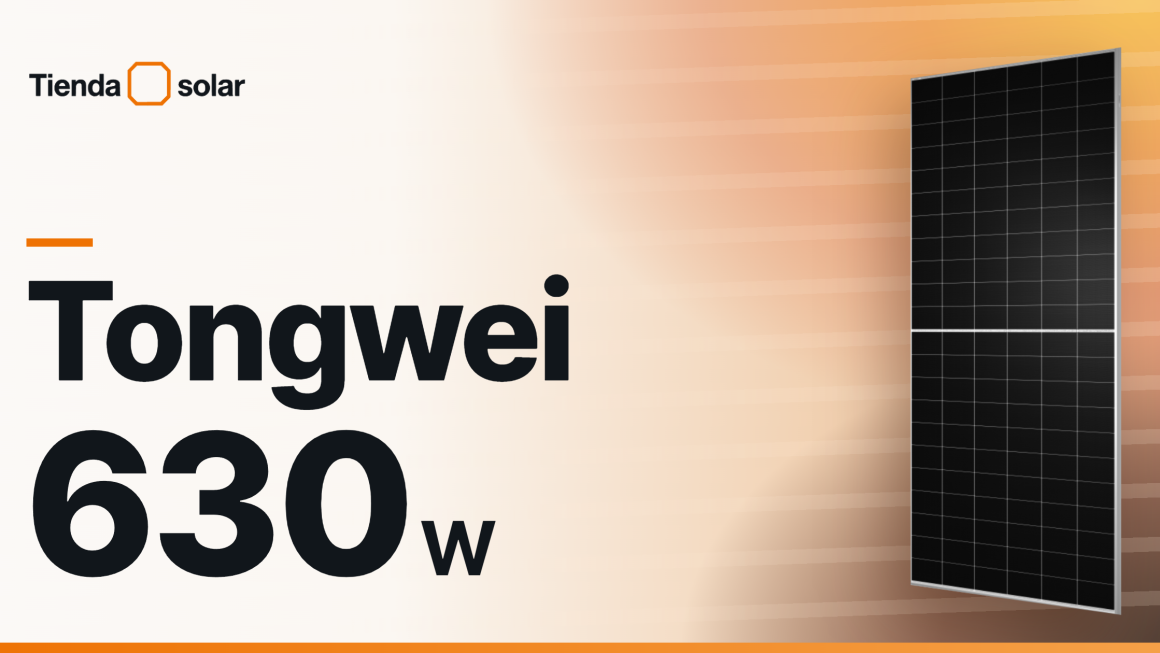
If you are looking for Tongwei solar panels offering the best value for money on the market, here is the full range available. The standout is the Tongwei 630W TNC 2.0 solar panel, a bifacial N-type TOPCon module with dual glass, 23.3% efficiency and a 30-year linear power warranty. It comes from the world’s leading manufacturer of photovoltaic cells.
Tongwei: the manufacturer behind many other brands’ panels
There are two types of companies in the photovoltaic market. Some buy cells from third parties, laminate them with glass and a frame, and put their logo on them. Others control the supply chain from the raw material onwards. Tongwei belongs to the second group, and it is the largest of them all. Its history is unusual. The group was founded in Sichuan (China) in the agri-food sector and entered the solar industry by producing high-purity polysilicon, the raw material from which every crystalline panel is made. Today it is the world’s leading producer of polysilicon and photovoltaic cells. Many module brands that end users recognise as “top tier” buy their cells from Tongwei. With Tongwei, you buy straight from the source, with no middlemen involved. This matters for three practical reasons:
Quality control from the silicon up. Silicon impurities and cell defects are the main cause of premature degradation and hot spots. A manufacturer that controls the silicon, the wafer, the cell and the module has full traceability.
Competitive pricing without cutting corners on quality. Because it does not pay a margin to a cell supplier, Tongwei can offer premium modules at mid-range prices. This is the foundation of its value for money.
Supply stability. During the polysilicon shortage years (2021-2022), assemblers without their own production ran out of material or raised prices. Integrated manufacturers kept on supplying.
https://youtu.be/moxWfjOS63E?si=qhpOdzIkp6Q7XOzF
Corporate strength: BloombergNEF Tier 1 and Fortune Global 500
When you buy a panel with a 30-year warranty, it is not only the panel that matters. It also matters that the manufacturer will still be around in 20 years to honour that warranty. Here, Tongwei has two weighty credentials:
BloombergNEF Tier 1. The BloombergNEF Tier 1 classification does not measure a panel’s quality in the lab. It measures its bankability: it includes manufacturers whose modules have been accepted by banks in non-recourse financed projects. In practice, it means financial institutions trust that the manufacturer will deliver. The Tier 1 seal appears on the module’s own datasheet.
Fortune Global 500. Tongwei Group is part of the Fortune Global 500 ranking, which lists the world’s 500 largest companies by revenue. Tongwei presents itself as the only photovoltaic manufacturer included in that list. This is especially relevant in an industry where many brands have disappeared after price wars.
On top of this, it holds management system certifications (ISO 9001, ISO 14001, ISO 45001 and ISO 50001) and the PV-specific manufacturing certification IEC 62941:2019. It also has an EcoVadis sustainability rating and a carbon footprint verified by Certisolis. This last point is increasingly relevant in projects that require sustainability criteria or in public tenders.
Tongwei 630W TNC 2.0 solar panel (TWMNH-66HD): product description
The Tongwei TWMNH-66HD630W belongs to the TNC 2.0 family, which covers 620 to 640 W. It is a bifacial N-type half-cell module with 132 half-cells in a 6×22 layout, built with dual glass: 2.0 mm front glass with an anti-reflective coating and 2.0 mm rear glass, both semi-tempered. It has an anodised aluminium frame. The manufacturer targets it mainly at commercial and industrial (C&I) rooftops and ground-mounted solar plants. It is also a good fit for homes with plenty of available space, agricultural installations, industrial buildings and carports.
What is TNC 2.0 technology?
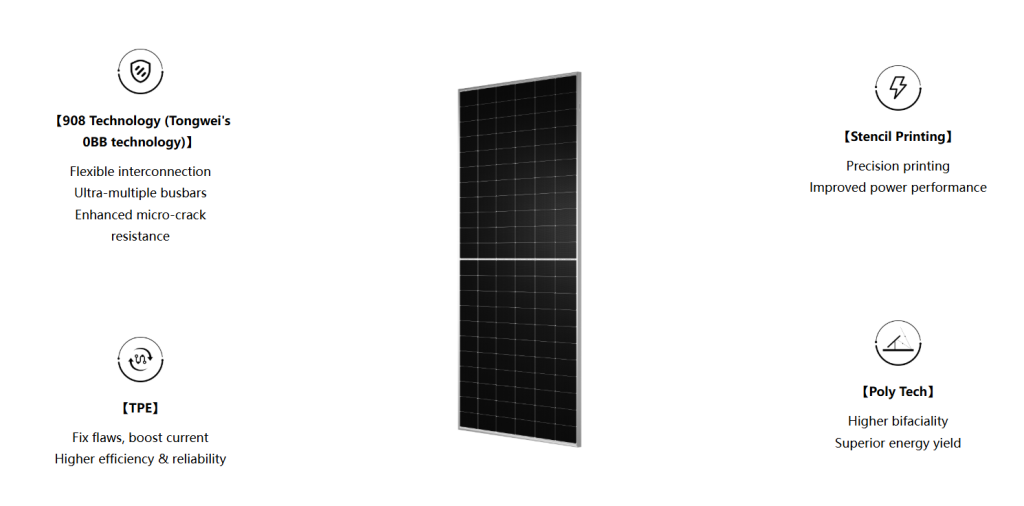
TNC is the name Tongwei uses for its TOPCon (Tunnel Oxide Passivated Contact) technology on N-type silicon wafers. Version 2.0 is the second-generation evolution. In short:
The N-type wafer (phosphorus-doped) does not suffer from the light-induced degradation (LID) or light and elevated temperature-induced degradation (LeTID) typical of boron-doped P-type PERC cells. That is why the panel loses less power in the first year and in the years that follow.
The ultra-thin tunnel oxide layer and the doped polysilicon on the rear reduce electron recombination. More of the electrons generated end up as usable current, which translates into higher efficiency.
The TOPCon structure is inherently bifacial. The rear side also produces energy from light reflected off the ground or roof.
The result is a technology that competes head-on in the race for efficiency and in reducing LCOE (levelised cost of energy, i.e. how much each kWh produced costs you over the entire lifetime of the installation).
Tongwei 630W technical specifications
Electrical parameters (STC: 1000 W/m², 25 °C, AM 1.5)
Parameter
630 W value
Maximum power (Pmax)
630 W (tolerance 0/+3%)
Open-circuit voltage (Voc)
49.50 V
Short-circuit current (Isc)
16.18 A
Voltage at maximum power (Vmp)
41.10 V
Current at maximum power (Imp)
15.33 A
Module efficiency
23.3%
Bifacial output
Under BNPI conditions (1000 W/m² on the front and 135 W/m² on the rear), the 630 W module reaches 695.4 W. Depending on the actual rear-side gain of each installation:
Rear-side gain
Power
Equivalent efficiency
5%
661 W
24.5%
15%
724 W
26.8%
25%
787 W
29.1%
Its bifaciality factor is 80 ± 5%: the rear side delivers up to 80% of what the front would produce under the same irradiance.
Temperature coefficients
Coefficient
Value
Pmax
−0.28%/°C
Voc
−0.24%/°C
Isc
+0.046%/°C
Mechanical and operating parameters
Parameter
Value
Dimensions
2382 × 1134 × 30 mm
Weight
32.2 kg
Junction box
IP68, 3 bypass diodes
Cable
4 mm² (+400/−200 mm or ±1400 mm)
Maximum static load
5400 Pa front / 2400 Pa rear
Maximum system voltage
1500 V DC
Maximum series fuse rating
30 A
Operating temperature
−40 °C to +70 °C
Packaging
36 pcs/pallet · 720 pcs per 40′ HC container
Warranty
12-year product warranty (materials and workmanship).
30-year linear power warranty: a maximum loss of 1% in the first year and 0.4% per year thereafter. This means 89.4% of rated power at 25 years and 87.4% at 30 years.
Product certifications: IEC 61215 (2021), IEC 61730 (2023), IEC TS 62804 (PID), IEC 61701 (salt mist), IEC 62716 (ammonia) and IEC 60068-2-68 (sand and dust). You can find out what each standard covers on the website of the International Electrotechnical Commission (IEC).
Benefits of the Tongwei 630W panel: why it’s a smart buy
1. Less degradation: more kWh over the entire lifespan
Degradation is the silent enemy of profitability. A conventional PERC panel typically guarantees a loss of around 2% in the first year and 0.55% per year after that, leaving it at roughly 84.8% after 25 years. The Tongwei TNC 2.0 guarantees 89.4% over the same period. That is about 4.6 more percentage points of power in year 25. The advantage grows year after year and, added up over the module’s entire lifetime, amounts to several thousand additional kWh for every medium-sized installation. Those kWh come free: you have already paid for the panel.
2. Better performance in the heat: key in Spain and Portugal
On a Spanish rooftop in July, cell temperature easily reaches 65 °C, i.e. 40 °C above laboratory conditions (STC). With that difference:
Tongwei TNC 2.0 (−0.28%/°C): loses 11.2% and delivers around 559 W.
Typical PERC panel (−0.35%/°C): loses 14%. Applied to the same rated power, it would drop to around 542 W.
In the months of highest production, which is when you get the most out of self-consumption, the real difference can be around 3% in favour of TOPCon. In the south of the Iberian Peninsula, that advantage shows up on your electricity bill.
3. Savings on mounting and labour: fewer modules per kWp
This is the most overlooked benefit, and the one that weighs most on the final budget. For a 10 kWp installation:
Panel
No. of modules
Approx. clamps/fixings
450 W
23
~92
550 W
19
~76
Tongwei 630 W
16
~64
Seven fewer modules than with a 450 W panel means fewer rails, fewer clamps, fewer MC4 connectors, less cabling and fewer installation hours. In commercial installations of 100 kWp or more, the difference amounts to dozens of modules and several days of crew time. If you need mounting systems, our solar panel mounting structures section offers flush-mount, tilted and ground-mount options compatible with large-format modules.
4. Dual glass: durability for demanding environments
Glass-glass construction protects the cells against moisture, micro-cracks and PID (potential-induced degradation) better than a module with a polymer backsheet. Together with its salt mist, ammonia and sand/dust certifications, this makes it suitable for coastal areas, farms and agricultural operations, and regions affected by dust storms.
5. Extra energy from the rear side
On a flat roof with a white membrane or over light-coloured gravel, the rear side can contribute between 5% and 15% of additional energy. With an elevated structure and good albedo, even more. It is production that a monofacial panel simply cannot give you.
Uses and applications of the Tongwei 630W
Industrial buildings and commercial rooftops (C&I): this is its natural territory. Large surfaces, stable daytime loads and the need to minimise LCOE. Combined with multi-MPPT three-phase grid-tie inverters, it is one of the most cost-effective options on the market.
Ground-mounted solar plants and agrivoltaics: the 1500 V DC maximum voltage allows long strings and reduces cabling, and bifaciality can be fully exploited on elevated structures.
Detached homes with space: on large roofs or garden installations, just a few modules cover all your demand. For self-consumption with storage, the ideal is to combine it with hybrid inverters and lithium batteries that provide backup.
Off-grid installations and solar pumping: on rural estates, irrigation systems or livestock farms, its robustness and resistance to ammonia and dust are a real plus.
Solar carports and pergolas: the dual glass lets some light through between the cells while the rear side keeps producing, making it both attractive and functional.
If you prefer a ready-made solution with everything already sized, our solar kits offer panel, inverter and battery combinations ready to install.
2026 buying guide: what to check before choosing the Tongwei 630W
A 630 W panel is not simply a bigger 450 W panel. It has technical implications worth reviewing:
Inverter current (the most important point). With an Isc of 16.18 A (which rises slightly with heat), you need an inverter whose MPPT can accept that short-circuit current. Many older or entry-level residential inverters limit the input to 13-15 A per string. Before buying, check the inverter’s datasheet. Current mid-range and premium models, both solar inverters and hybrids, are usually already designed for high-current modules.
Microinverters. Not all microinverters accept modules over 600 W with more than 16 A. If your installation has partial shading and you want to use microinverters, check compatibility model by model.
String sizing in cold weather. Voc increases by 0.24% for every degree below 25 °C. At −10 °C, each module can reach around 53.7 V. With a 1000 V inverter, a maximum of about 18 modules fit in series. With a 500-600 V residential inverter, between 9 and 11. Always calculate it using the historical minimum temperature in your area.
Size and weight. At 2.38 m long and 32.2 kg, it takes two people to handle, and you need to check that the roof and structure can bear the load, especially in windy or snowy areas.
Realistic bifaciality. On tiles or dark metal sheeting, flush-mounted, the rear-side gain will be minimal (0 to 5%). To get the most out of bifaciality you need an elevated structure and a light-coloured surface.
Permits and legalisation. In Spain, self-consumption is regulated by Royal Decree 244/2019. IDAE (the Spanish Institute for Energy Diversification and Saving) publishes up-to-date guides on procedures and regional grants.
Frequently asked questions about Tongwei solar panels
Is Tongwei a reliable brand? Yes. It is the world’s leading producer of polysilicon and photovoltaic cells, it is classified as Tier 1 by BloombergNEF and the group is part of the Fortune Global 500. Few brands in the industry have that kind of financial backing to stand behind a 30-year warranty. What is the difference between TOPCon (TNC 2.0) and PERC? TOPCon uses an N-type wafer and a tunnel passivation layer that reduces electrical losses. In practice: higher efficiency (23.3% vs. the typical 20-21% of PERC), less degradation (0.4%/year vs. ~0.55%) and better performance in the heat (−0.28%/°C vs. ~−0.35%/°C). Is the Tongwei 630W panel suitable for a home? Yes, as long as there is enough space (each module takes up around 2.7 m²) and the inverter can handle its current of over 16 A. On small or highly fragmented roofs, a smaller-format module may be more practical. How many Tongwei 630W panels do I need? As a rough guide, in Spain one kWp produces between 1,400 and 1,700 kWh/year depending on the area. For household consumption of 5,000 kWh/year, 5-6 modules of 630 W (3.2-3.8 kWp) are usually enough. For a business consuming 50,000 kWh/year, you are looking at around 50 modules. What warranty do Tongwei panels come with? A 12-year product warranty and a 30-year linear power warranty, with 89.4% of power guaranteed at 25 years and 87.4% at 30 years. Which inverters is it compatible with? Any inverter whose MPPT voltage range and maximum input current match the module. Manufacturers such as Huawei, Fronius, Deye, Solis, GoodWe and Fox ESS offer current models designed for high-current panels. Always check the specific model’s datasheet.
Expert Opinion
The Tongwei 630W TNC 2.0 is not a panel for everyone, and it is better to say so plainly: if your roof is small, has several pitches or forces you to fit modules one by one between chimneys and skylights, a 2.38-metre module will make your life harder rather than save you money. Where this panel shines is on industrial buildings, commercial rooftops, rural estates and homes with clear, open space. There, every module you don’t have to install is a set of clamps, a length of rail and some installation time you don’t pay for. The most interesting part is in the datasheet’s small print. The −0.28%/°C coefficient and the 0.4% annual degradation are the two figures that really bring LCOE down, because they give you more kWh in August and keep giving them to you in year twenty, when a PERC panel has already lost several more points. What almost everyone forgets is the inverter. With an Isc of over 16 amps, this module does not fit many older or entry-level residential units. Many people only find out when the MPPT is already clipping production, so it pays to check the maximum input current before finalising the quote, and also whether your microinverter supports it. Nor should you get carried away by bifacial figures of 700 W or more: flush-mounted on tiles, the rear side contributes very little. My recommendation is simple. If you have the space and a modern mid-range or premium inverter, this Tongwei is one of the best-value panels you can install today. It is backed by a manufacturer that produces its own silicon and has the financial muscle to honour its warranty three decades from now, and in photovoltaics, long-term reliability counts for more than an extra watt today.
Pol Parareda Farriol es ingeniero industrial y MBA, con más de 15 años de experiencia internacional en el sector de la energía solar fotovoltaica y las energías renovables. Actualmente Director en Tienda Solar, trabaja en el desarrollo y gestión de soluciones de autoconsumo, sistemas fotovoltaicos y almacenamiento con baterías para el mercado residencial y profesional.
A lo largo de su carrera ha ocupado puestos de responsabilidad en empresas líderes del sector como Weidmüller, SunPower, Sunco Capital y Hilti, desempeñando funciones en ingeniería, desarrollo de producto, operaciones, O&M, gestión comercial y dirección estratégica de proyectos solares, tanto a pequeña escala como en grandes plantas fotovoltaicas internacionales.
Ha liderado proyectos y equipos en Europa, Latinoamérica y Asia, participando en el desarrollo de más de cientos de MW en proyectos solares, negociación de PPAs, estrategias EPC y optimización de sistemas fotovoltaicos. Además, ha sido docente de energía solar fotovoltaica en programas de máster en energías renovables en instituciones como la Universidad Carlos III de Madrid